🎁 Buy 2 kits, get the 3rd FREE · Free shipping on every order

Book Nook vs Diorama: Which Format Fits Your Creative Goals?
Book nooks and dioramas both capture miniature worlds, but they serve very different creative purposes. This guide breaks down the key differences in format, display, difficulty, and intent so you can pick the right project with confidence.

Two Miniature Worlds, Two Very Different Answers
A book nook slots between books on a shelf and uses forced perspective to create depth, while a diorama is a freestanding miniature scene with no fixed dimensions, both build tiny worlds, but where they live and how they work are completely different. I still remember the exact moment I understood the difference. It was a rainy Sunday in 2021, and I had just slotted my first completed Victorian dollhouse kit onto the shelf between two chunky hardbacks. The little bay window caught the fairy lights, the wallpaper I had fussed over for two evenings glowed amber, and my husband walked past, stopped, and said, “wait, is that a whole room in there?” That reaction was my introduction to forced perspective, to the idea that a miniature scene gains something entirely different when it lives inside another object rather than sitting free in the world. That question, of whether a piece belongs inside a shelf or open on its own terms, is exactly what the book nook vs diorama debate is really about.
You are standing in a craft store, or scrolling at midnight through a rabbit hole of tiny staircases and glowing lanterns, and you feel it: the pull toward building something impossibly small and completely yours. The question is which format actually fits your life. Book nook vs diorama is not just a matter of aesthetics. It is a question of where the piece will live, how long you want to spend building it, and what kind of satisfaction you are chasing.
Both formats produce miniature scenes. Both reward patience. But they operate on completely different logic, and choosing the wrong one can turn an exciting project into a frustrating one. So let us sort that out properly.
What a Book Nook Actually Is (and Is Not)
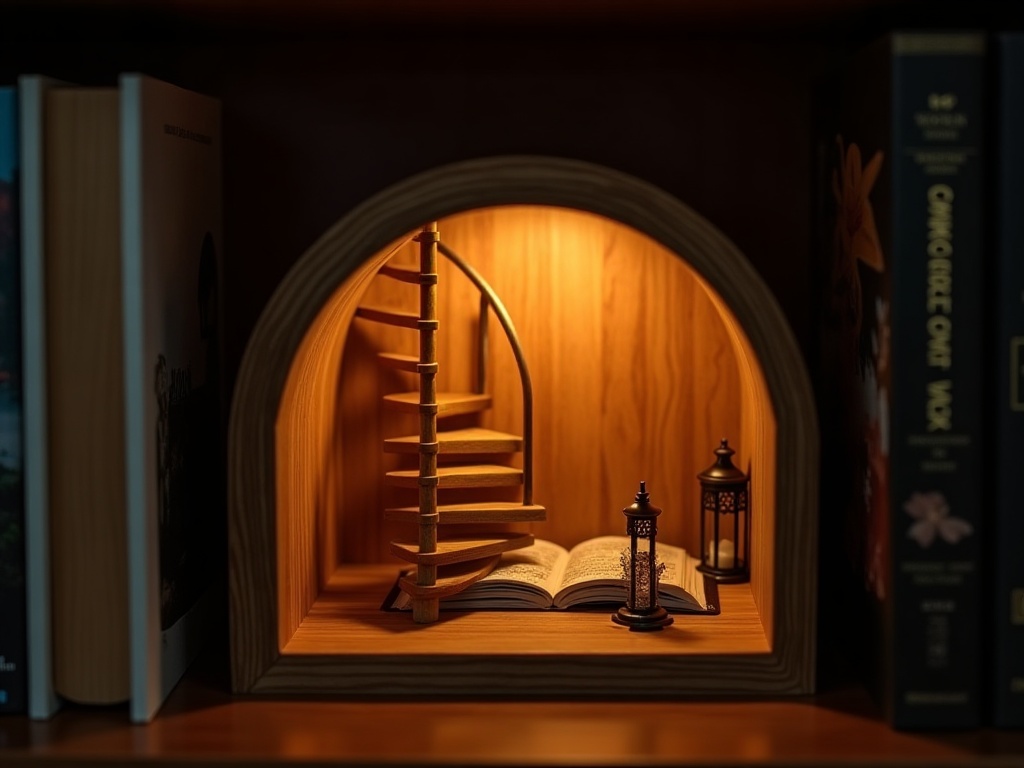
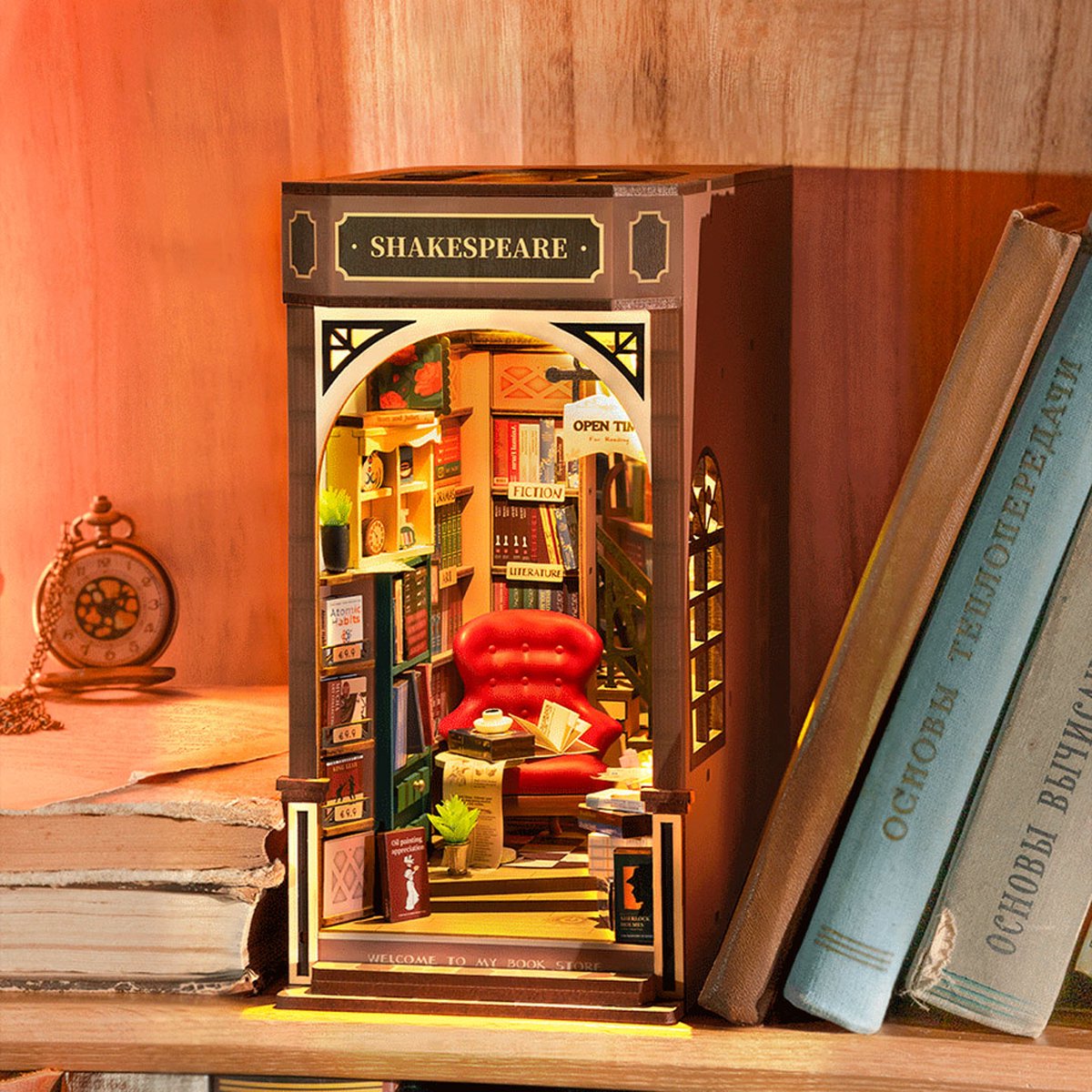
A book nook is a miniature scene built inside a rigid insert that slots between books on a shelf, using layered forced perspective and integrated LED lighting to make a narrow slot look like a portal into another world. A book nook is a miniature scene built inside a rigid insert that slots between books on a shelf. The magic trick is the illusion of depth: a tunnel-like perspective that makes a narrow slot of space look like it stretches back into another world. Some people call them “book inserts” or “shelf inserts,” but the community-wide term is book nook.
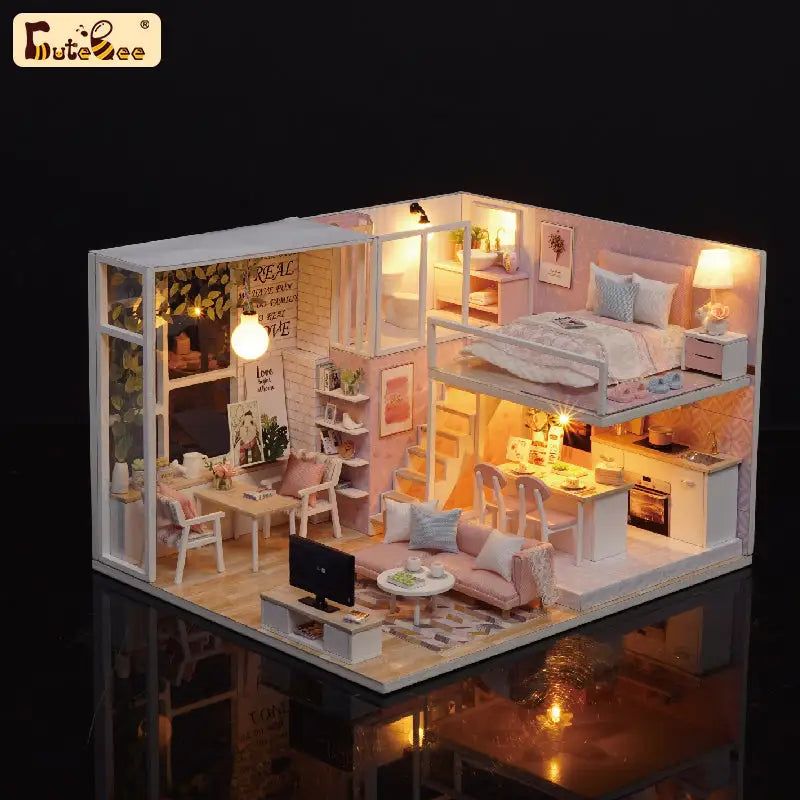
Bestseller cottage kit
Tranquil Life DIY Miniature House Kit
Difficulty: Level 2 of 4 · Est. build time: 8-12 hrs · Includes laser-cut panels, LED strip, pre-scaled furniture, and full instructions
$67.90
The format has a strict constraint baked right into its design. It must fit a bookshelf slot, typically somewhere between 3 and 6 inches wide and 8 to 12 inches tall, and it has to look convincing when viewed straight-on from a standing or seated position. That constraint is not a limitation so much as a creative challenge: you are forced to think about forced perspective, layering, and light.
What Makes a Book Nook Distinctive
- Forced perspective design: The scene is engineered to look deeper than it is. Layers get smaller as they recede, tricking the eye.
- Integrated lighting: Most kits and builds include LED strips or fairy lights. The glow is part of the effect, especially at night.
- Shelf-ready display: No pedestal, no shadow box, no glass dome needed. The bookshelf is the display.
- Thematic coherence: Book nooks almost always reference literary or fictional worlds: fantasy libraries, cozy cottages, urban alleyways.
If you already own a bookshelf and you want a piece that lives inside it naturally, a book nook is the format built for exactly that. Community members who have shared their finished builds on our social pages often mention that the moment of “slotting it in for the first time” is its own little ceremony, something a freestanding diorama simply cannot replicate.
📜 Did you know?
The modern book nook trend began circulating in maker communities around 2018-2019, largely driven by Japanese and Korean craft kit manufacturers who adapted traditional miniature house building into a shelf-compatible format. By 2023, the hashtag #booknook had surpassed 500 million views on TikTok alone, making it one of the fastest-growing miniature niches in hobby history.
The modern book nook trend began circulating in maker communities around 2018-2019, largely driven by Japanese and Korean craft kit manufacturers who adapted traditional miniature house building into a shelf-compatible format. By 2023, the hashtag #booknook had surpassed 500 million views on TikTok alone, making it one of the fastest-growing miniature niches in hobby history.
What a Diorama Is Built For
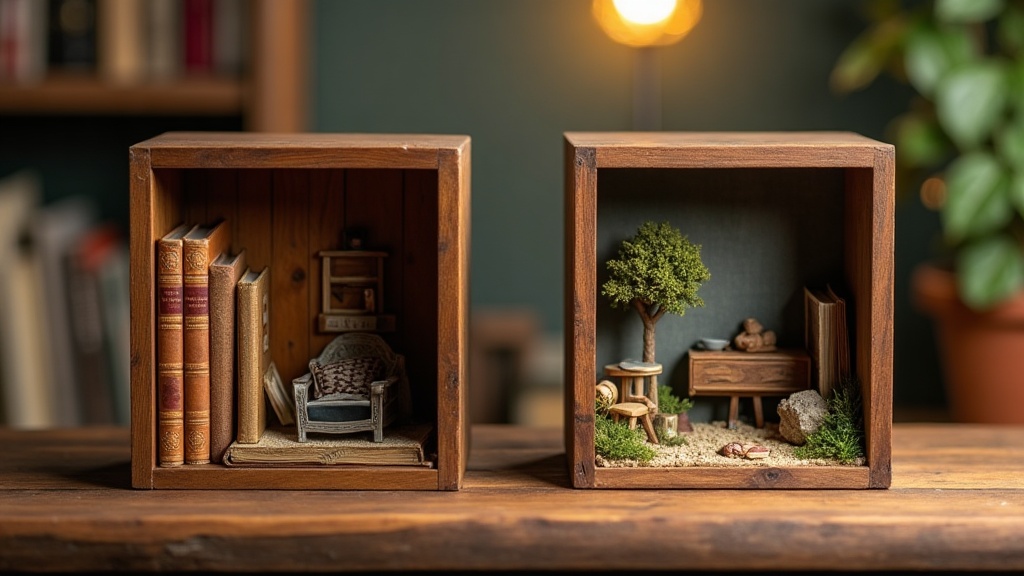
A diorama is a three-dimensional miniature scene displayed in an open or enclosed box, free from shelf-slot constraints, letting you build wide panoramas, mixed-media nature vignettes, or architectural cross-sections at whatever scale and depth you choose. A diorama is a three-dimensional miniature scene displayed in an open or enclosed box, typically viewed from the front or at a slight angle. The word itself comes from the Greek dia (through) and horama (that which is seen), and the format has been used in museums, military modeling, and natural history exhibits for over two centuries.
A diorama has far fewer dimensional constraints than a book nook. It can be wide, shallow, deep, tall, or sprawling. It can sit on a desk, a mantle, a shelf, or inside a glass case. The scene does not need to trick the eye into seeing depth it does not have; it can simply have the depth itself.
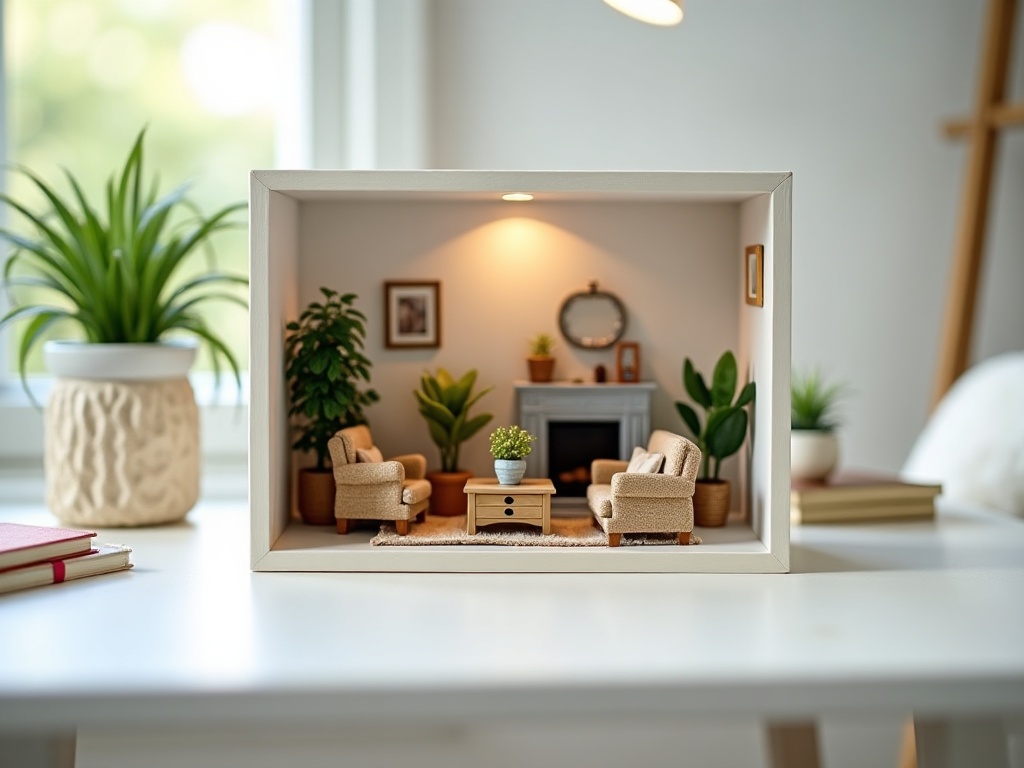
Explore the collection
All Book Nook Kits
76 handcrafted book nook kits · Difficulty levels 1-4 · Beginner to advanced
The Core Strengths of the Diorama Format
- Scene freedom: You can build wide horizontal panoramas, battlefield scenes, nature vignettes, or architectural cross-sections without worrying about slot width.
- Viewing angles: A diorama can be designed to be viewed from multiple sides, or even from above like a dollhouse floor plan.
- Material variety: Resin, foam, clay, plaster, fabric, natural moss, sand. Dioramas invite mixed media in a way that book nooks do not always accommodate.
- Scale flexibility: Common scales range from 1:6 (fashion doll scale) to 1:144 (quarter scale), and nothing enforces a specific one.
The diorama format suits builders who want total creative control over composition. You decide the frame, you decide the viewing angle, you decide whether the piece sits open on a table or protected inside a shadow box. For crafters who have already completed a kit or two and feel the itch to design their own scene from scratch, the diorama is a natural next step. Several customers have written to us saying their first miniature house kit was the thing that gave them the skills and confidence to attempt a custom diorama build.
Book Nook vs Diorama: A Side-by-Side Comparison
The clearest difference between a book nook and a diorama comes down to where it lives: book nooks are built for a shelf slot with forced perspective and integrated lighting, while dioramas are freestanding scenes with flexible dimensions and optional lighting.
| Factor | Book Nook | Diorama |
|---|---|---|
| Display location | Between books on a shelf | Desk, table, mantle, display case |
| Typical width | 3-6 inches | Varies freely (4 to 24+ inches) |
| Core technique | Forced perspective, depth illusion | Realistic spatial arrangement |
| Lighting | Almost always included | Optional, style-dependent |
| Kit availability | High, purpose-built kits | Moderate, often sourced piecemeal |
| Typical build time | 4-15 hrs (difficulty level 1-4) | Highly variable; 6 hrs to several weeks |
| Beginner-friendly? | Very, with guided kits | Depends heavily on materials |
| Best for gifting? | Yes, highly giftable format | Yes, if recipient has display space |
✨ Hannah’s tip
If you are buying a first kit for someone else, go with a book nook every single time. The forced-perspective reveal moment, when they slot it into their shelf and watch an entire world appear between two paperbacks, lands harder than almost any other craft gift I have seen. It also removes the display-space question entirely since it works on any shelf they already own.
If you are buying a first kit for someone else, go with a book nook every single time. The forced-perspective reveal moment, when they slot it into their shelf and watch an entire world appear between two paperbacks, lands harder than almost any other craft gift I have seen. It also removes the display-space question entirely since it works on any shelf they already own.
✅ Key takeaway
A book nook is the lower-friction choice for first-time miniature builders: the dimensions are fixed, the scene is pre-planned, and the kit includes everything you need. A diorama rewards crafters who already know what they want to build and have the workspace to plan it freely. Both are genuinely satisfying. The difference is in how much of the creative scaffolding you want pre-built for you.
A book nook is the lower-friction choice for first-time miniature builders: the dimensions are fixed, the scene is pre-planned, and the kit includes everything you need. A diorama rewards crafters who already know what they want to build and have the workspace to plan it freely. Both are genuinely satisfying. The difference is in how much of the creative scaffolding you want pre-built for you.
Difficulty, Time, and the Building Experience
Book nook kits are the more structured entry point: fixed dimensions, pre-planned scenes, and step-by-step instructions mean most beginners finish a level 1 or 2 kit in a single weekend, while scratch-built dioramas demand more upfront planning before a single piece is placed. This is where the two formats split most dramatically for beginners.
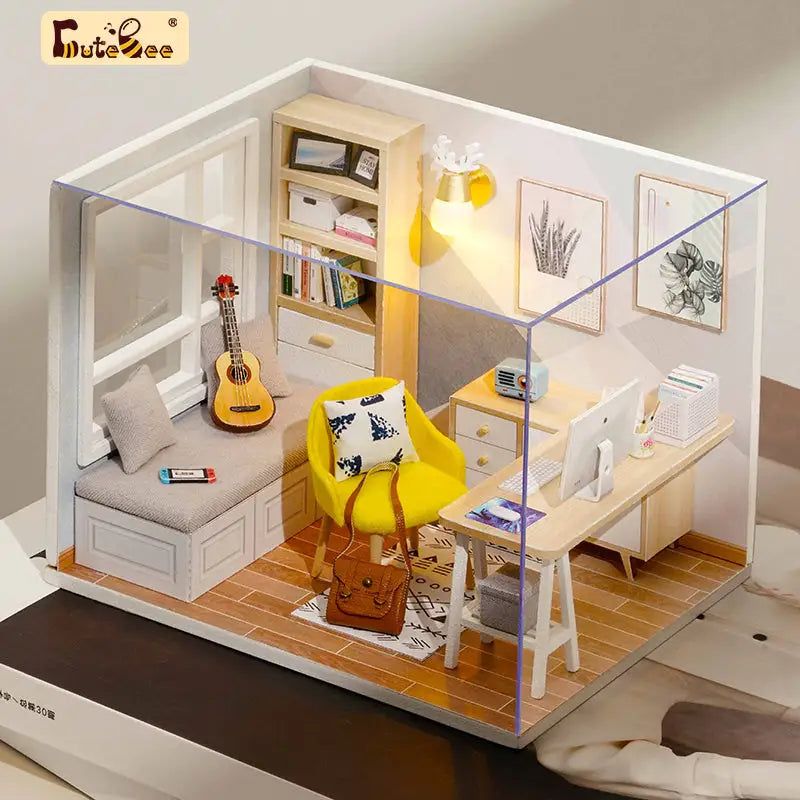
Easy starter under $50
Sun Room DIY Miniature House Kit
Difficulty: Level 1 of 4 · Est. build time: 4-6 hrs · Includes all panels, LED lighting, furniture pieces, and step-by-step guide. No prior experience needed.
$49.99
The Book Nook Building Experience
A kit-based book nook is one of the most structured entry points in miniature building. You receive laser-cut wooden panels, pre-scaled furniture pieces, lighting hardware, and step-by-step instructions. The box dimensions are fixed. The scene composition is already planned. Your job is to paint, assemble, and add your personal touch.
Difficulty ratings in our book nook kits collection range from 1 (beginner-friendly, no prior craft experience needed, roughly 4-6 hours) up to 4 (advanced builders, intricate wiring and multi-layer construction, 15+ hours). Most first-time builders land comfortably in the 1-2 range and finish a weekend project with a piece they are genuinely proud of.
The meditative aspect is real. Because the steps are structured and the outcome is visible in layers, you get small wins every 20 minutes. Cut a tiny windowsill, paint it, attach it, and the scene advances. That rhythm is one of the most common things community members mention in their build logs. One customer, Priya, sent us a photo of her finished Sun Room kit alongside a note that said: “I started this on a Tuesday evening feeling anxious. By Thursday I had forgotten to feel anxious.” That is the thing a structured kit can do that a blank diorama cannot, at least not yet.
⚠️ A word of caution
Difficulty ratings assume you have basic craft supplies on hand: a quality PVA glue, fine-tipped tweezers, and a craft knife. If you are picking up a Level 3 or 4 kit as your very first miniature project, set aside a little extra time on day one just to get comfortable with the scale. The pieces are small, and patience with small pieces is a skill you build as you go.
Difficulty ratings assume you have basic craft supplies on hand: a quality PVA glue, fine-tipped tweezers, and a craft knife. If you are picking up a Level 3 or 4 kit as your very first miniature project, set aside a little extra time on day one just to get comfortable with the scale. The pieces are small, and patience with small pieces is a skill you build as you go.
The Diorama Building Experience
A scratch-built diorama requires more planning before you touch a single material. You need to decide the scale, source compatible furniture and figures, build or buy the enclosure, and plan the scene composition yourself. For experienced crafters, that open canvas is exactly the appeal. For beginners, the lack of guardrails can stall a project before it starts.
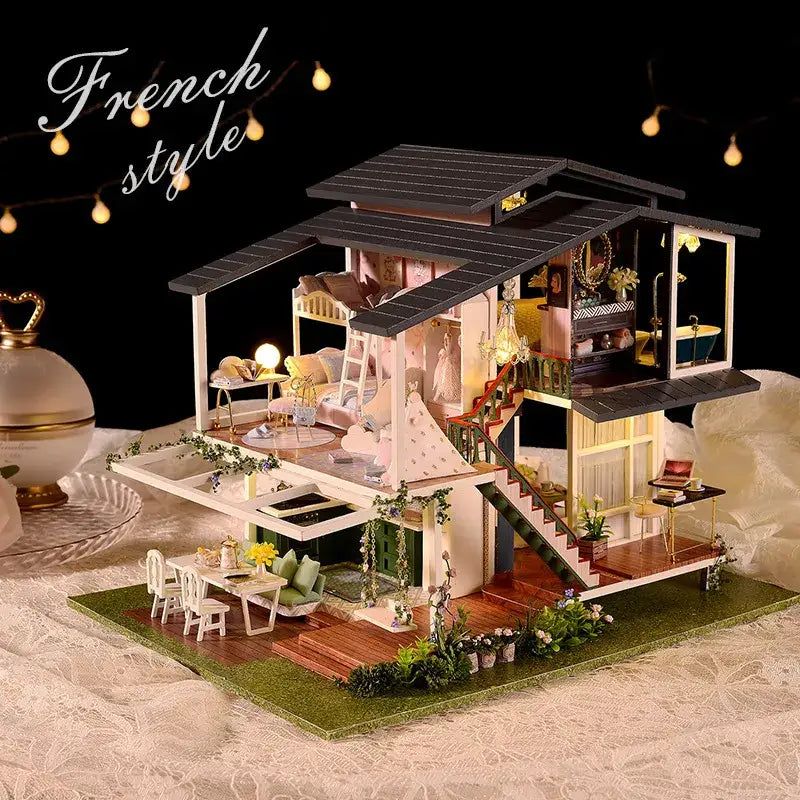
Rare in the niche
Miniature Greenhouse Kits
22 LED-lit greenhouse builds · Difficulty levels 2-4 · Each kit includes all structural components, plant details, and warm LED lighting
Pre-packaged diorama kits do exist, particularly in the military modeling and architectural miniature spaces, but they are less common than book nook kits and tend to assume more baseline knowledge. If you are newer to miniature work, a beginner miniature diorama kit will still ask you to make more independent decisions than a comparable book nook kit at the same skill level. That is not a flaw in the format; it is just honest about what it is.
Which Format Works Best as a Gift
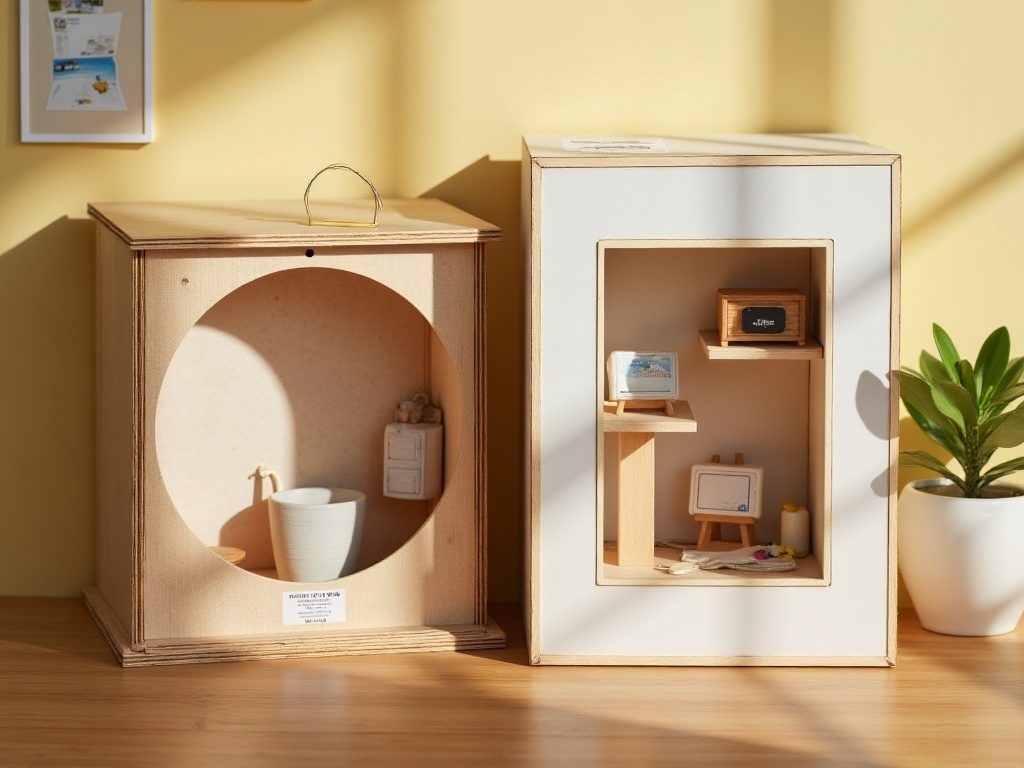
A book nook kit is the safer gift for almost any recipient: it is compact, self-contained, works on any existing shelf, and delivers the unmistakable “forced-perspective reveal” moment that makes a diorama simply cannot match as an unboxing experience. Both formats photograph beautifully and signal genuine thoughtfulness to a recipient. But the practical logistics differ enough that it matters which one you pick.
A book nook kit is almost universally giftable. The recipient needs a shelf (nearly everyone has one), some basic craft supplies like glue and paint, and a free weekend. The box is compact. The instructions are self-contained. You can pair it with a fantasy-themed book nook kit or a cozy cottage insert depending on their personality, and it will work in any home.
A diorama kit or diorama-focused gift is better suited for someone you know has a dedicated display space, a craft table, and some prior miniature experience. It is a deeply personal project, which makes it wonderful when the fit is right and potentially overwhelming when it is not.
For gift buyers who are uncertain about the recipient’s experience level, the book nook format removes most of the risk. Check out our full range of book nook kits for gift-givers for sets that include everything needed from start to finish, no extra supply runs required. The community members who have gifted our kits most often tell us the same thing: the recipient finishes it and immediately starts looking for their next one.
Premium collector piece
Monet’s Garden DIY Miniature House Kit
Difficulty: Level 3 of 4 · Est. build time: 12-18 hrs · Includes garden panels, hand-painted flower details, warm LED system, and full illustrated guide. A meaningful gift for an experienced builder.
$155.00
Frequently Asked Questions about Book Nooks and Dioramas
Everything you might be wondering (click a question to expand).
Can a complete beginner build a book nook or diorama?
Absolutely. A Level 1 book nook kit is specifically designed for people who have never picked up a craft knife or painted a miniature wall. Everything is pre-cut, pre-scaled, and pre-planned. The instructions walk you through each step in order, and the typical finish time is a single weekend. Beginners consistently report finishing their first kit and feeling genuinely surprised by the result. A scratch-built diorama asks for more upfront planning, so a kit is the better starting point if you are brand new to the craft.
Which is cheaper: a book nook kit or a diorama kit?
Entry-level book nook kits start around $35-$50 and include all components. Scratch-built dioramas can appear cheaper upfront (a shadow box frame plus loose supplies) but the sourcing time and the risk of incompatible scales often push the real cost higher. If you are comparing like for like (a complete kit versus a complete kit), book nooks and diorama kits land in similar price ranges. The book nook vs diorama cost question is really more about hidden time costs than sticker price.
Can I display a book nook outside of a bookshelf?
Yes. While the format is designed for shelf display, many builders prop their book nooks on a desk using small wooden stands or lean them against a wall as a standalone piece. The forced perspective still works from a straight-on viewing angle regardless of where the insert sits.
Are dioramas harder to build than book nooks?
Not necessarily harder, but typically less guided. A diorama requires more self-directed planning around scale, scene composition, and sourcing. A book nook kit supplies those decisions for you. For first-time miniature builders, that structure makes kit-based book nooks the lower-friction starting point.
What scale do most book nook kits use?
Most commercial book nook kits work at approximately 1:24 or 1:12 scale for furniture and figures. The box itself is scaled to fit a standard shelf slot. Kits in our collection specify exact internal dimensions so you can confirm fit before purchasing.
Can I combine book nook and diorama techniques?
Absolutely. Many advanced builders treat their book nook as a diorama project, scratch-building elements, adding resin water effects, or sculpting custom figures in clay. The book nook format provides the frame; what you put inside it is limited only by the dimensions. Some of the most impressive builds in our community gallery started as standard kits and became fully custom scenes over several sessions.
Which format holds its value better for display long-term?
Both formats hold up well when sealed and kept away from direct sunlight. Book nooks have a slight practical edge because they are enclosed on three sides by the surrounding books, which protects the scene from dust accumulation. Dioramas displayed in open boxes benefit from a glass or acrylic cover over time.
How to Pick Your First Project Without Second-Guessing Yourself
If you have a bookshelf and want a guided, lighting-included kit with a clear finish line, start with a shelf insert; if you have craft experience and a specific scene in mind that needs more space, a diorama gives you that freedom. Here is the short version. If you have a bookshelf, you want lighting included, and you want a structured kit that walks you through every step, start with a book nook. Browse the book nook kits collection and filter by difficulty rating to find your level. You will have a finished piece on your shelf before you second-guess a single decision.
If you have craft experience, a dedicated workspace, and a clear scene in mind that does not fit neatly between two books, a diorama gives you the freedom to build exactly that. Start with a shadow box frame, plan your scale, and source your pieces with intention. You might also find our miniature house kits useful as a bridge step: they offer the same open-scene feel as a diorama but with the structural guidance of a kit.
The book nook vs diorama choice is not a ranking. Neither format is better. They are built for different builders at different moments. The one that matches where you are right now is the right one to start. And if you are still not sure, reach out through our contact page. I read every message, and I am genuinely happy to recommend a starting point based on your shelf setup, your budget, and how many free hours you have on a Sunday.