🎁 Buy 2 kits, get the 3rd FREE · Free shipping on every order

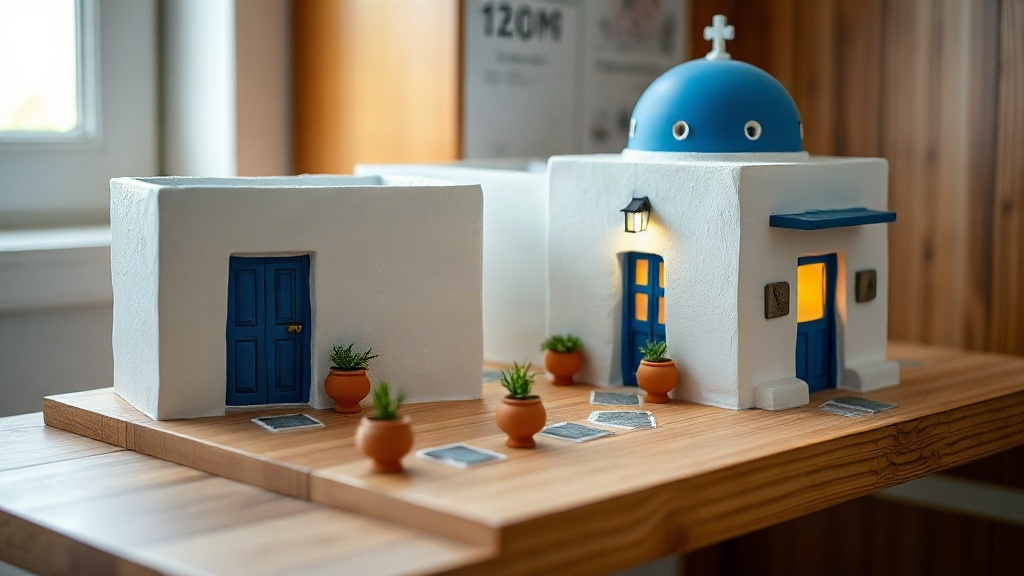
Capturing the Essence of Santorini: Building a Greek Island Miniature Scene
Learn how to build an authentic Greek island miniature scene inspired by Santorini's iconic white-washed architecture and cobalt blues. This guide covers design principles, building techniques, material selection, and styling tips for creating a Mediterranean retreat in miniature form.

There’s something magnetic about Santorini. The way those white-washed cubic buildings cling to volcanic cliffs above a deep blue sea has captivated travelers and artists for centuries. I still remember the afternoon I finished my first Victorian dollhouse kit on a rainy Sunday in 2021 and thought: what if I could capture this feeling, the silence of a tiny world waiting to be explored, but with Mediterranean sun instead of English fog? Building a Greek island miniature scene lets you capture that Mediterranean magic at your own pace, on your own shelf. And honestly? It’s one of the most satisfying projects I’ve ever shared with our community.
The beauty of this project lies in its accessibility. You don’t need advanced carpentry skills or exotic materials. What you do need is a clear understanding of the architectural language that makes Santorini unmistakable: clean geometry, bold color contrast, and details that whisper rather than shout.
Understanding Santorini’s Architectural DNA
Santorini’s whitewashed cubic buildings evolved from genuine necessity: compact forms protected residents from intense Aegean winds, thick walls regulated heat naturally, and flat roofs doubled as outdoor living terraces, giving every structure a logic you can honor in miniature. When you recreate these elements at small scale, you’re not just copying a pretty picture; you’re honoring centuries of island engineering.
The color palette is deceptively simple. White dominates the structures themselves, achieved traditionally with lime-based plaster that ages beautifully. Blue appears in doorways, window shutters, and roof domes. Not all blues work equally; Santorini favors a rich, saturated cobalt that contrasts sharply with the white. This isn’t a pale sky blue or a washed-out periwinkle. It’s bold, intentional, and absolutely essential to authenticity.
Accent colors matter too. Terracotta trim, natural wood doors, and occasional splashes of magenta bougainvillea add warmth. But these are supporting players. The white and blue relationship carries the entire visual weight of a Greek island miniature scene.
Choosing Your Scale and Base
Working at 1:12 scale is the most practical choice for a Santorini diorama: it’s large enough to carve meaningful architectural details into doorways and windows without needing a magnifying glass, yet compact enough for a two-to-four-building scene to fit comfortably on a standard shelf.
Your base matters more than you might think. A wooden platform, roughly 24 by 18 inches, gives you room for two to four buildings plus streets, vegetation, and sky backdrop. Plywood accepts paint beautifully and won’t warp as your scene ages. Choose marine-grade plywood if you’re building this in a humid climate; the extra cost prevents warping that can crack your buildings later.
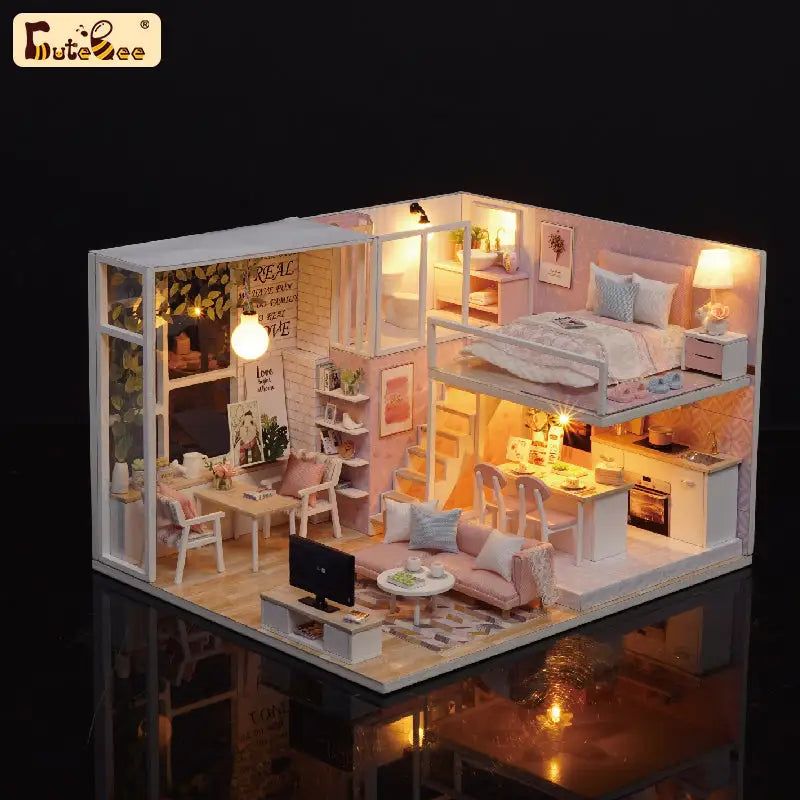
Practice kit before Santorini
Tranquil Life DIY Miniature House Kit
Perfect for practicing wall painting and trim work before your Santorini build.
$67.90
View this kit →
Paint the base before assembly begins. A soft gray-white for stone pathways, moving to deeper blue tones as you recede into “distance,” creates atmospheric perspective even without a painted backdrop. This simple gradient teaches the eye to read depth.
📜 Did you know?
Santorini’s distinctive architecture wasn’t designed purely for aesthetics. The cubic form minimizes surface area exposed to harsh winds, and the white plaster reflects up to 97% of solar radiation, keeping interiors cool without modern air conditioning. Medieval builders understood climate-responsive design centuries before it became trendy.
Santorini’s distinctive architecture wasn’t designed purely for aesthetics. The cubic form minimizes surface area exposed to harsh winds, and the white plaster reflects up to 97% of solar radiation, keeping interiors cool without modern air conditioning. Medieval builders understood climate-responsive design centuries before it became trendy.
Building Structures: White-Washed Walls and Clean Lines
Building authentic Santorini walls comes down to two decisions: choose either foam board (forgiving and lightweight) or basswood (premium and detail-friendly), then seal every surface with primer before any paint touches it, so your white stays crisp rather than streaky.
Paint walls with acrylic in pure white or near-white (a touch of cream prevents it from feeling sterile). Two coats are usually sufficient. The key here is consistency; your buildings should read as a unified ensemble, not isolated structures. Commit to a single white formulation across every building from the start; mixing brands mid-project creates a patchwork effect that no amount of touch-up fixes.
Details transform a flat wall into an authentic building facade. Carve or glue on shallow trim around windows and doors. These details don’t need to be deep; 1/8-inch shadow lines create surprising visual impact that reads clearly even from across a room. A skilled builder can hand-cut these details with a craft knife, but pre-made trim from miniature supply stores saves time and frustration for beginners.
Weathering adds credibility. A very light gray wash, applied selectively to crevices and lower walls, suggests age without screaming “I’m an old building.” Restraint is the operative word. One of the most common mistakes is over-weathering, which muddies the crisp white aesthetic that makes Santorini iconic.
Color and Character: The Blue Element
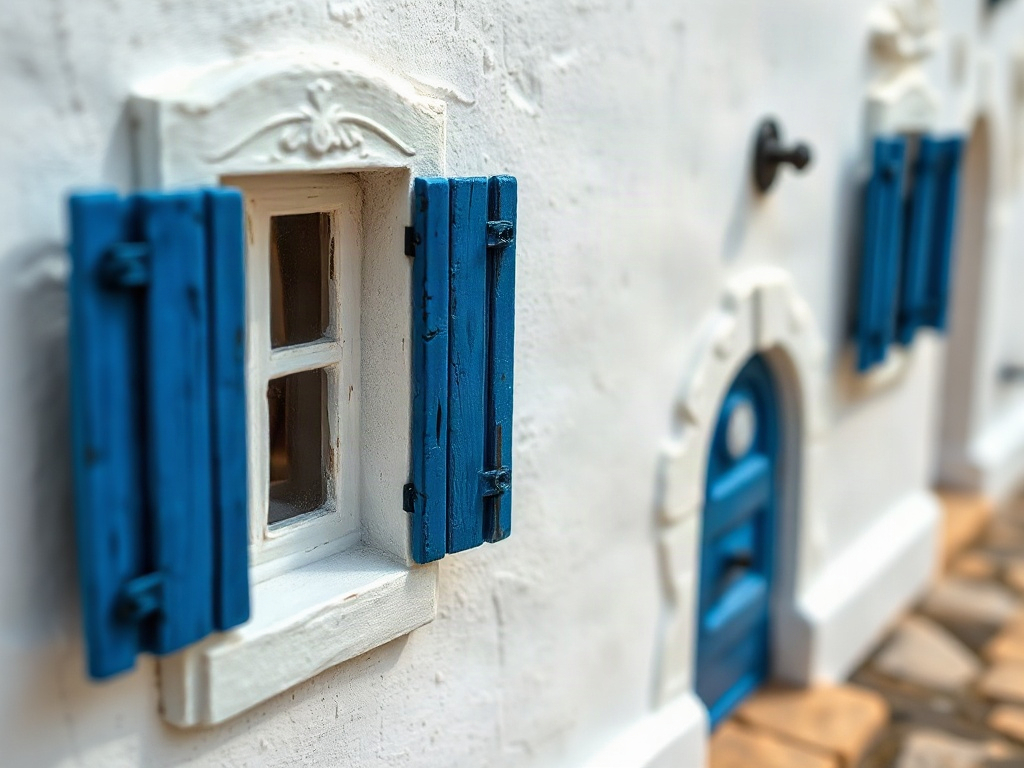
The right cobalt blue is the single most important paint decision in your entire Santorini miniature: choose a deep, saturated shade close to hex #004e89, test it on scrap wood under your display lighting, and never substitute a pale periwinkle or dusty sky blue, which drain all the drama from the scene.
Blue is where your scene comes alive. Doors, shutters, window frames, and decorative trim in cobalt blue create visual rhythm across your white structures. The contrast between white and blue should feel bold and intentional.
Select your blue carefully. Compare paint samples under natural light and indoor lighting before committing to a full bottle. Test on scrap wood first; what looks right in the bottle can shift once it dries.
Explore the collection
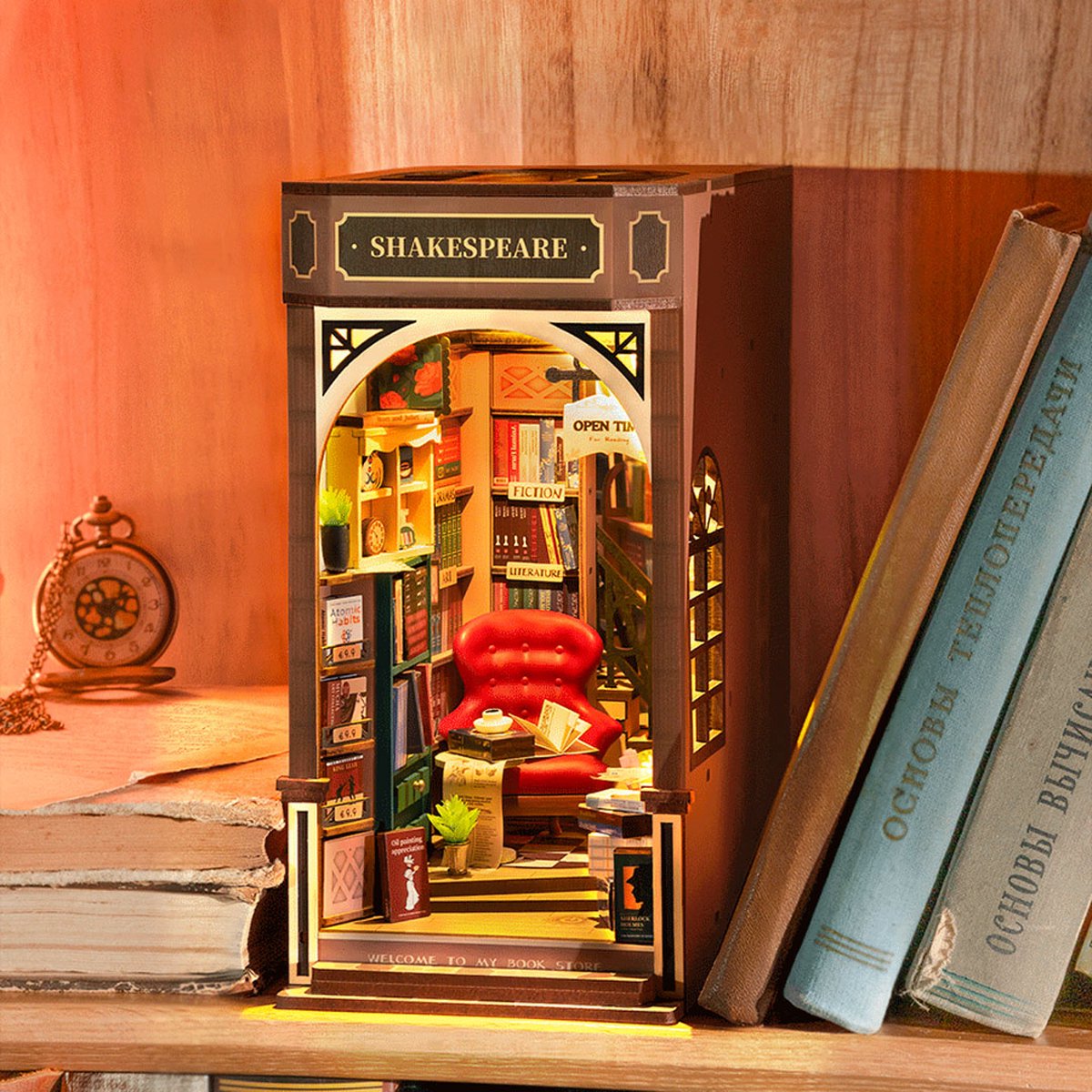
All Book Nook Kits
76 handcrafted book nook kits, great for practising layered painting techniques before tackling a larger diorama.
76 handcrafted book nook kits
Browse all book nooks →
Apply blue trim in layers. Paint the main shutter or door frame, let it dry, then add slightly darker blue for depth in recessed areas. This layering creates dimension that flat color cannot achieve.
🪄 Hannah’s tip
Paint your smallest blue details last, after the white walls are complete. Use a fine brush and quality acrylic paint formulated for miniatures. These paints have better pigment density than craft acrylics, meaning your blues stay true without multiple coats. It’s a small investment with visible results.
Paint your smallest blue details last, after the white walls are complete. Use a fine brush and quality acrylic paint formulated for miniatures. These paints have better pigment density than craft acrylics, meaning your blues stay true without multiple coats. It’s a small investment with visible results.
Rooflines, Domes, and Distinctive Silhouettes
The signature element that instantly reads as “Santorini” rather than any other white village is the blue or white dome: even a single well-executed dome among flat-roofed structures transforms your miniature settlement into something unmistakably Aegean.
Santorini’s roofline silhouette is its calling card. Flat roofs with low parapets dominate, but occasional curved domes in blue or white punctuate the skyline. These domes aren’t functional; they’re visual poetry, referencing Orthodox church architecture while serving the practical purpose of breaking up an otherwise monotonous roofline.
Creating dome shapes at 1:12 scale requires patience. Cast resin dome kits are available from specialty retailers, or you can form them from papier-mache over a mold, then seal and paint. A well-executed dome, even a modest one, elevates your entire scene from “nice building” to “authentic Greek island settlement.”
Keep rooflines clean. Avoid excessive clutter or decorative elements that would distract from the simple, geometric elegance of the design. Terracotta roof tiles, if you include them, should be subtle and secondary to the overall white and blue story.
Streets, Stairs, and Pathways
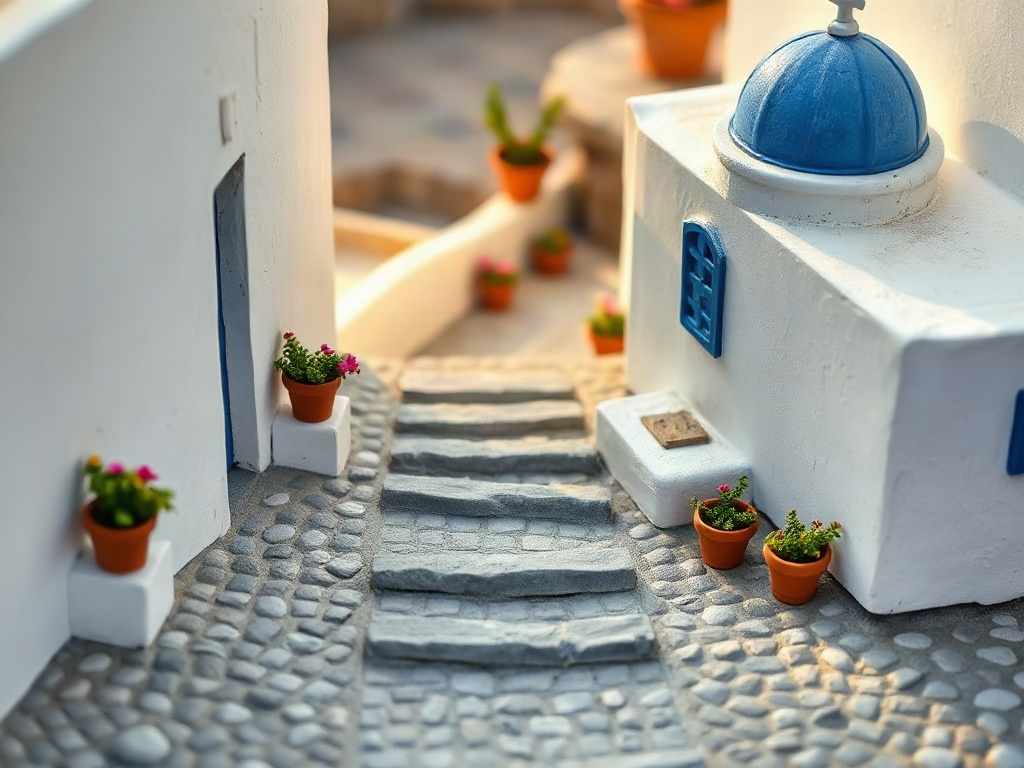
Santorini’s narrow, steep cobblestone paths deserve as much attention as your building facades: they ground the entire Greek island miniature scene in a specific place, and varied elevation levels connected by stairs are what make your diorama feel like a real settlement rather than a flat arrangement of boxes.
Stone tile sheets, available from miniature retailers, provide an authentic base. Alternatively, create cobblestone texture using fine foam board or modeling clay, texturing it with tools or toothpicks to suggest individual stones. Paint with a warm gray or taupe, then dry-brush lighter gray across raised edges to show wear and age.
Stairs connecting different elevation levels add drama. Santorini clings to steep terrain, so varied elevations feel authentic. Use this advantage; build some structures higher than others, connected by stairs. This creates visual interest and makes your scene feel like an actual place rather than a flat arrangement.
Build your base skills first
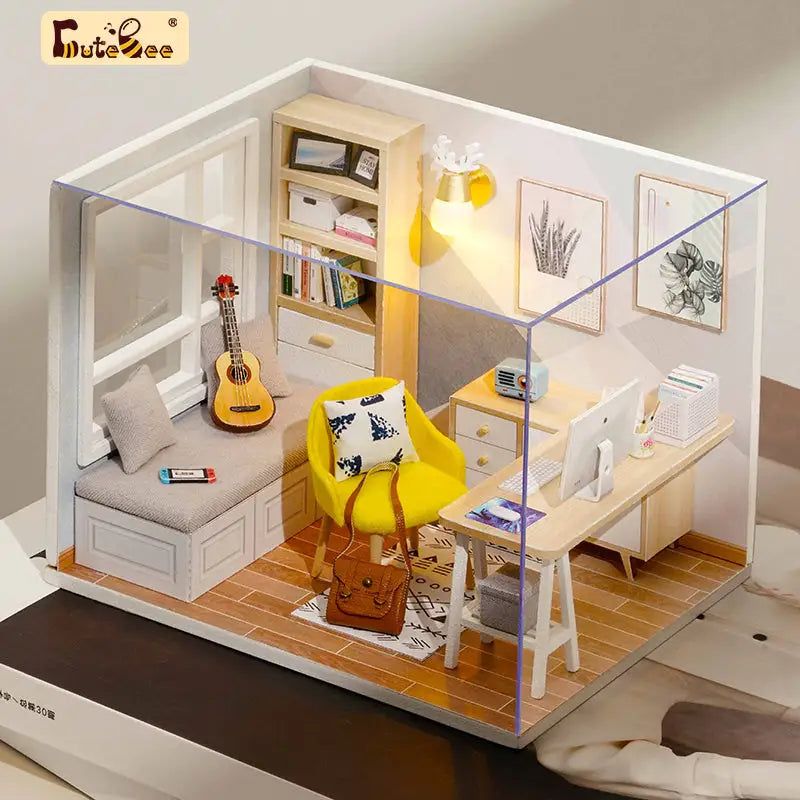
Sun Room DIY Miniature House Kit
The flooring and pathway techniques in this kit translate directly to laying Santorini-style stone paths.
$49.99
Start with this kit →
Landscape and Vegetation Elements
Mediterranean vegetation in your miniature should feel sparse, sculptural, and purposeful: cluster preserved bougainvillea near doorways, place a single scaled olive tree as a focal point, and resist the urge to fill every corner, because empty stone pathways are just as important as the plants themselves.
Use preserved flowers, dried botanicals, or quality miniature plants. Scale matters critically here; a 1:12 olive tree should reach roughly 8 to 10 inches tall. Check suppliers specializing in miniatures; generic craft plants often feel cartoonish and out of proportion.
Placement is subtle. Position flowering plants near doorways and windows, as if they’ve self-seeded in crevices. A few clustered pots near an entrance is more believable than random plants scattered everywhere. This restraint reinforces the authenticity of the scene.
Lighting and Display
Warm white LED strips wired through your buildings before final assembly are the single upgrade that most transforms a Santorini diorama: at 2700K color temperature, the glow through windows suggests evening light spilling onto cobblestones and makes visitors stop and look twice.
Light transforms a daytime scene into something magical. Tiny LED strips, wired through buildings and hidden behind walls, create a warm glow suggestive of evening light spilling from windows and street lamps.
Position lights before you seal and glue final elements. Test them under different angles; what looks great from straight-on might cast harsh shadows from the side. Avoid direct sunlight on display, which fades blues especially quickly; a shelf with gentle ambient lighting or a display case with integrated lighting shows off your work safely over the long term.
Common Mistakes and How to Avoid Them
Rare in the niche
Miniature Greenhouse Kits
22 LED-lit greenhouse builds
See our greenhouse range →
Five predictable errors account for nearly every disappointing Santorini build, and knowing them in advance saves hours of frustrating rework. Beginning builders often stumble on all five in their first attempt, which is why I flag them here before you pick up a brush.
The first is inconsistent white. Using different white paints or finishes across buildings creates an unintended patchwork. Commit to one white formulation across all structures.
The second is blue that’s too pale or too purple. Test your blue thoroughly before committing to large surfaces. A swatch on painted foam board under your display lighting beats guessing.
Third: excessive aging and weathering. Santorini’s buildings are regularly whitewashed. Subtle hints of age are appropriate, but a heavily worn, grimy appearance breaks the aesthetic.
Fourth is overcrowding. Beginners want to fill every inch of base space. Restrain yourself. Empty stone pathways and open breathing room make your scene feel larger and more authentic.
Finally, neglecting scale consistency. Mixing 1:12 and 1:24 elements confuses the eye. Decide on your scale and source every element to that standard. I learned this the hard way with my very first build, placing a 1:24 door frame next to a 1:12 pot plant, and the whole corner looked like it belonged in two different universes.
Personalization: Making It Your Own
The most memorable Santorini miniatures always carry one personal detail that no kit could supply: a tiny book on a windowsill referencing a favorite novel, a street name painted in Greek letters from a village you dream of visiting, or a color accent that means something only to you.
While authenticity matters, your scene belongs to you. Subtle personalizations transform a replica into a creation. Perhaps you include a tiny version of your favorite Mediterranean herb in the garden. Maybe you reference a specific village or corner of Santorini you’ve visited or dream of visiting.
Add narrative elements carefully. A book on a windowsill, laundry drying on a line, a small table with painted chairs. These aren’t distracting additions; they’re invitations for viewers to imagine stories unfolding in your miniature world.
Your Greek island miniature scene becomes a meditation on place and memory. The meditative quality of building, the satisfaction of completing details, the joy of stepping back to see your creation assembled. These experiences transcend the final photograph. I felt exactly that same quiet joy when I finished my first Victorian dollhouse and discovered the hobby that eventually became this community; Santorini just wraps it in Mediterranean sunshine.
For builders ready for a challenge
Monet’s Garden DIY Miniature House Kit
The landscape and LED lighting techniques here are the closest in our range to what a Santorini scene demands at advanced level.
$155.00
Discover this kit →
Frequently Asked Questions about Greek Island Miniature Scenes
Everything you might be wondering (click a question to expand).
What’s the best wood for building Santorini-style structures?
Basswood and foam board are both excellent choices for Santorini-style walls. Basswood accepts detail work beautifully and feels premium, though it requires basic carpentry tools. Foam board is more forgiving for beginners, lighter to handle, and still capable of stunning results. Avoid particleboard, which crumbles and warps.
How long does a complete Greek island scene typically take to build?
A two to three-building scene with pathways and landscape elements takes 30 to 50 hours spread over several weeks. This allows paint and adhesives to cure properly and gives you time to assess how sections work together before moving forward. Patience produces better results than rushing.
Can I create this scene as a gift for someone?
Absolutely, a finished or partially finished Santorini scene makes a deeply personal and memorable gift. It’s especially meaningful for someone who appreciates craftsmanship or holds travel memories of the Aegean. You might build the structures and let them personalize landscape and interior details, creating a collaborative keepsake.
What’s the best way to protect a finished scene from dust and fading?
A glass display case offers the best combined protection from dust and UV damage. If a case isn’t feasible, keep the scene on a shelf away from direct sunlight and consider a removable acrylic cover. Regular gentle dusting with a soft brush maintains appearance without damaging details.
Are there premade Greek island kits, or do I need to build from scratch?
Several manufacturers offer Santorini-inspired miniature house kits in various difficulty levels. Kits provide pre-cut materials and instructions, which accelerates the building process. Building from raw materials takes longer but offers complete creative control. Your choice depends on whether you value speed or artistic freedom more.
Which techniques from other miniature kits transfer most directly to a Santorini build?
Flat-wall painting, dry-brushing stone textures, and LED wiring are the three skills that transfer most directly. If you’ve completed a cottage-style or garden miniature kit, you already know the core wall and landscape workflow. The Santorini-specific additions are the cobalt color discipline and the dome-forming technique, both of which you can practise on scrap material before touching your main build.
Bringing Mediterranean Light and Life Home
A completed Greek island miniature scene is one of those rare shelf objects that genuinely stops people in their tracks, because it combines the satisfying geometry of architecture with the warmth of personal craft in a way that photographs never quite capture.
A Santorini diorama is never truly finished. The most experienced builders continue refining details, adjusting lighting, and rotating seasonal elements. This evolution is part of the joy. Your scene grows richer as you live with it, add new discoveries, and share it with fellow enthusiasts in our community.
The meditative act of building, combined with the stunning visual payoff, makes this project remarkably satisfying. Whether you’re capturing a memory of a trip to Santorini or crafting an imagined escape, you’re creating something tactile and meaningful. That tactile, meditative quality is the real reason so many builders tell me this was the project that turned a rainy-afternoon hobby into a genuine passion. That’s the real magic of miniature building.